


Last week, I shared the story of one of my most admired mentors telling me, “You can’t do that.” At the time, the resistance to fashionable plus-size clothing wasn’t really about whether women wanted it. (My research had already told me they did.)
The bigger obstacle was perception. Buyers weren’t convinced the plus-size customer was a market worth focusing on, and many in fashion still believed certain styles simply wouldn’t look as good on a woman with curves.
I didn’t believe either assumption. And before long, the customers themselves were going to prove just how wrong they were.
It’s hard to remember just how different the fashion world was in the late 1990s and early 2000s. There was no Instagram, no TikTok, and no body-positivity movement filling our feeds with women of every shape and size. For the most part, the images of beauty we saw were chosen for us by magazines, advertising and television.
And, if you were a plus-size woman flipping through a major fashion magazine, you might get one page. Seriously, one page. A magazine hundreds of pages thick might dedicate a single page to fashion available in larger sizes.
That sounds almost unbelievable today, but at the time, even that little bit of space created an opportunity. Because there were so few designers creating fashionable clothing for women with curves, Kiyonna quickly became a go-to resource for editors looking to feature plus-size fashion.
We were fortunate enough to be featured in magazines including Glamour, Essence, MODE, BBW, Mademoiselle, InStyle and others.
For a little company like Kiyonna, seeing our name in a national magazine was a huge deal. But then came the obvious question: once women found us, how were they actually supposed to buy the clothes?
Online shopping as we know it today really didn’t exist yet. While some wonderful independent boutique owners took a chance on Kiyonna early on, those boutiques were scattered around the country.
If a woman saw Kiyonna in a magazine but didn’t live near one of the boutiques that carried us, there really wasn’t an easy way for her to buy anything. Women were finding us and wanting the clothes, we just didn’t have a good way to get the clothes to them.

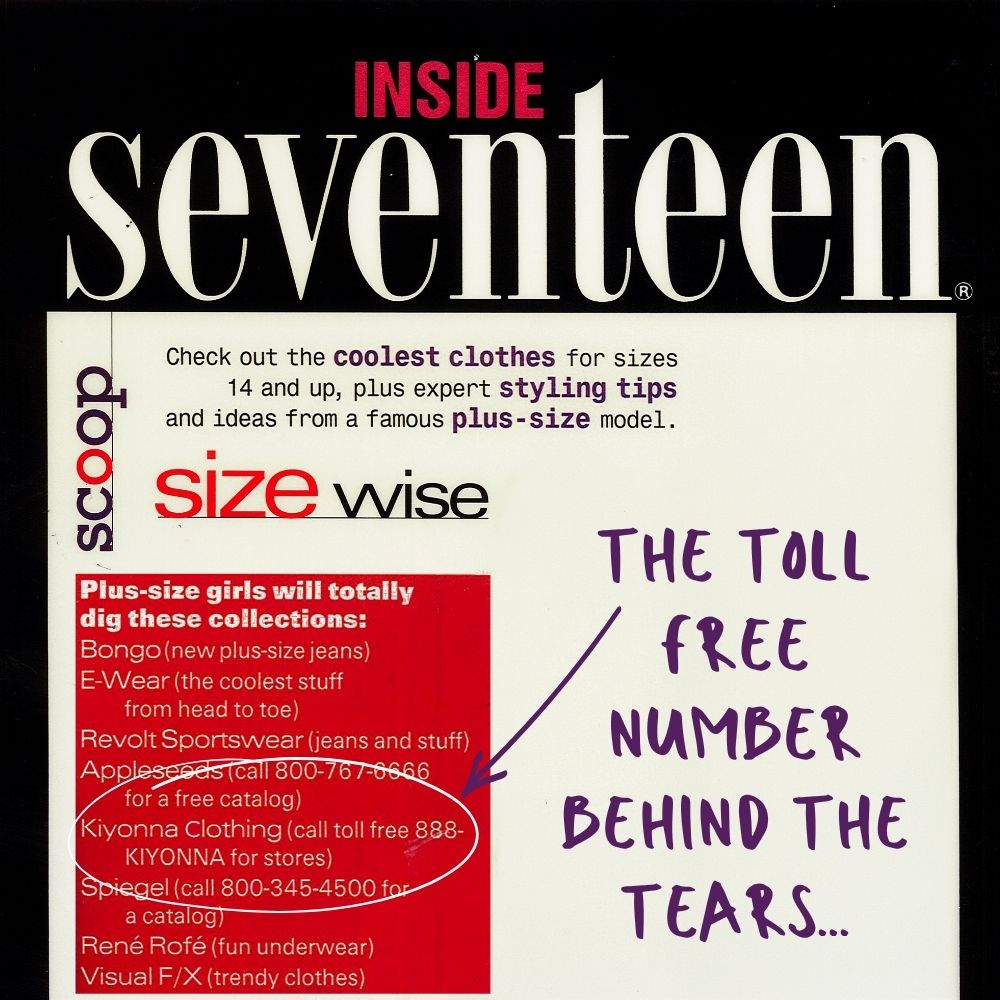
An editor included Kiyonna as a resource for fashionable plus-size clothing and listed our toll-free number: 1-800-KIYONNA.
The phone started ringing and ringing and ringing. It felt like we were getting a call every minute. Young women from all over the country were contacting us because they had seen Kiyonna and wanted to know one thing:

And far too often, we didn’t have a good answer. There might not be a boutique anywhere near them, and there was no easy way to simply order from us. We would talk to them, try to help, and then another call would come in. And then another.
At the time, it felt a little overwhelming.
Then, the phone bill arrived. It was something like $1,600.
For Kiyonna today, that would just be a business expense. For a brand-new company trying to figure out how to manufacture clothing, pay vendors and stay alive, it felt catastrophic. I remember looking at that bill and panicking about how we were even going to pay it.

At that moment, hundreds of phone calls didn’t look like validation to me. They looked like a $1,600 bill I wasn’t sure we had the money to cover.
Thirty years later, of course, I look at that bill very differently.
Those calls were actually telling us something incredibly important. The women were there. They wanted the clothes. They were willing to pick up a telephone, dial an 800 number they had found in a magazine and call a company they had probably never heard of before just to ask how they could buy something.
The problem had never been whether women with curves cared about fashion, and it certainly wasn’t that they couldn’t look beautiful in it.

We had created one side of the bridge, and the customer was standing very clearly on the other. Now we just had to figure out how to connect the two.
And strangely enough, the person who would plant the seed for how to do that wasn’t someone from the fashion industry. He wasn’t a retailer, and he definitely wasn’t a technology expert. In fact, he was from an entirely different generation and not particularly technological at all.
He was my dad.
One casual suggestion from him would eventually help change the way Kiyonna reached its customers forever. Today, roughly 99% of our customers connect with us through the very channel his idea helped lead us toward.
Back then, though, it sounded pretty crazy.
Next week: If You Build It, They Will Come.
How my dad helped spark the idea that would become our own little Field of Dreams.
Spoiler: Online shopping was about to change everything.